
A new era for emergency services
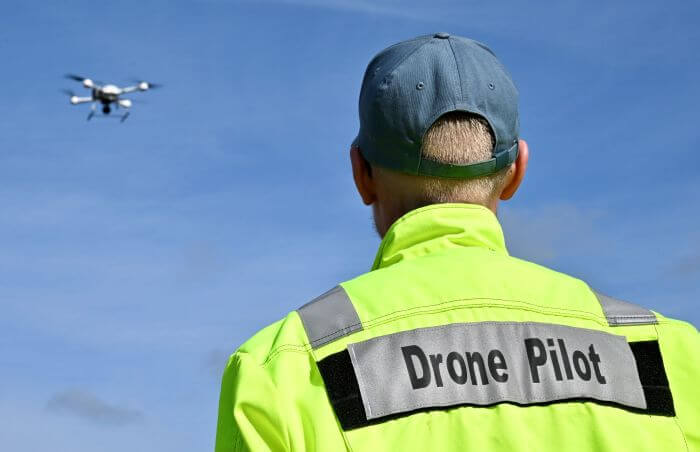
Imagine a forest fire spreading rapidly or a serious accident in a remote area. In such emergencies, every second counts, but rescue teams often lack the critical information they need in the first minutes. Phone calls alone cannot always convey the reality on the ground. To close this gap, Vodafone, Frequentis, the German Aerospace Center (DLR), and the Rostock Fire Brigade are testing a new solution: 5G-controlled drones that deliver live aerial images directly to control centres and emergency crews – even before the first vehicles arrive.
This innovation does not just save time. It gives emergency teams a clear, shared picture of the situation, enabling faster, safer, and more targeted action.
5G drones: a lifeline from the sky
The project, known as ADELE, combines Vodafone’s 5G technology with control centre software from Frequentis (LifeX and ASGARD). When an emergency call requires drone support, the system automatically dispatches a drone directly from the control centre.
These drones operate beyond visual line of sight (BVLOS) and are equipped with high-resolution cameras. Thanks to Vodafone’s real-time 5G network, they transmit live video to the control centre before any emergency vehicle leaves base.
For rescue teams, this means immediate insights into fire development, access routes, possible hazardous material storage, or the presence of people in danger. The result: response times drop from more than nine minutes to just two—a time gain that can mean the difference between life and death.
Shared situational awareness for faster action
As Günter Graf, Vice President New Business Development at Frequentis, explains:
“We bring video and sensor data immediately to our LifeX or ASGARD control centre and to approaching emergency responders. Everyone has the same, consistent information at all times, regardless of location. This shared situational awareness accelerates decision-making and ensures a faster, effective response.”
By integrating drone control into existing communication systems, Frequentis and the DLR simplify operations for emergency crews. Their Automated Drone Dispatch System (ADD) ensures smooth coordination by translating emergency call data into precise geocoordinates for drone deployment.
Security, compliance, and data protection
Of course, safety and data protection are essential. Andreas Volkert, DLR project lead, reassures:
“Our rescue drone combines high-resolution camera sensors with an optimised and low-risk flight trajectory. We ensure compliance with all legal regulations and full GDPR compliance to guarantee both security and data protection.”
This means that while drones add invaluable support, they also respect strict European regulations on both flight safety and personal data.
DroNet Hub: making BVLOS flights safer
One of the biggest challenges for BVLOS flights is approval. Authorities must evaluate risks, especially in populated areas. To streamline this process, Vodafone has developed the DroNet Hub.
This platform delivers dynamic ground and traffic data to assess risks and define safe routes. By simplifying approval processes, DroNet Hub ensures that emergency drones can fly quickly and securely. Authorities are already using it to strengthen drone traffic management.
Faster, clearer decisions for emergency services
Chris von Wrycz Rekowski, Senator for Finance, Digitalisation, and Order of the city of Rostock, summarises the benefit:
“With ADELE, we bring more speed and clarity to the daily operations of police, fire departments, and other emergency services. Live images not only give a better overview but also save valuable time. This allows faster and more accurate decisions—and an even faster response.”
For you as a reader, this means that the next time a forest fire, flood, or accident strikes, emergency responders could be equipped with an extra pair of eyes in the sky, working instantly to protect lives.
The road ahead: routine use of drones
For now, the ADELE project is in its first operational phase. The long-term goal is clear: to make automated drone deployment a standard part of emergency services across Germany—and, in time, across Europe.
If successful, this technology could reshape how emergency crews handle disasters, giving them a tool that is both faster and smarter than anything currently in use.
5G drones send live aerial images directly to control centres, giving crews vital information before they arrive on site.
They are currently being tested in Germany through the ADELE project with Vodafone, DLR, Frequentis, and the Rostock Fire Brigade.
The ADELE project has begun first operations, with the long-term goal of integrating drones into routine emergency response.
Conclusion: Technology that saves lives
The integration of 5G drones in emergency response is more than a technological breakthrough—it is a human achievement. By reducing response times, providing real-time data, and supporting decision-making, drones become a trusted ally for those who risk their lives to save others.
As emergencies grow in complexity—whether through climate change, urbanisation, or industrial risks—such innovations are not just useful, they are essential.
What do you think? Would you feel safer knowing that 5G drones are supporting your local emergency services? Could this technology become a standard tool in Europe and beyond? Share your thoughts in the comments below—we would love to hear your opinion.