

SkeyDrone unveils RunwaySafe, a revolutionary intelligent assessment tool designed to stop unnecessary airport shutdowns caused by harmless drone sightings.
RunwaySafe is officially setting a new benchmark in aviation security by providing airports with the intelligence needed to distinguish between minor drone presence and genuine aerial threats. As global air traffic becomes increasingly crowded, the ability to maintain operational continuity while ensuring safety has never been more critical.
The Rising Challenge of Drone Disruptions
Airports worldwide are currently grappling with a surge in uncrewed aerial vehicle (UAV) sightings. Historically, even a single unverified report could trigger an immediate runway closure, leading to a domino effect of flight delays, costly diversions, and thousands of frustrated passengers.
The primary issue isn’t just detecting the drone; it is the lack of situational awareness regarding the actual risk level. Without precise data, authorities often default to total shutdowns to avoid liability, even when the drone poses no physical threat to active flight paths. For more insights into the evolving world of drone technology, feel free to explore our dedicated section on UAVs.
How RunwaySafe Powers Intelligent Decision-Making
Developed in close collaboration with air traffic control (ATC) and airport operations teams, RunwaySafe moves beyond simple detection. It applies sophisticated aviation-grade logic to assess every sighting in real time.
« Airports cannot afford to close operations every time a drone is detected in controlled airspace, » says Stijn De Vleeschhouwer, Managing Director of SkeyDrone. The goal is to provide operational intelligence that allows for proportionate responses, ensuring that security measures match the actual danger level. To learn more about the engineering behind these solutions, visit the official SkeyDrone website.
« Airports cannot afford to close operations every time a drone is detected in controlled airspace, » said Stijn De Vleeschhouwer, Managing Director of SkeyDrone. « RunwaySafe provides the operational intelligence needed for airports and ANSPs to distinguish between irrelevant drone activity and genuine threats, enabling faster, safer and more proportionate decisions.”
From Raw Detection to Operational Support
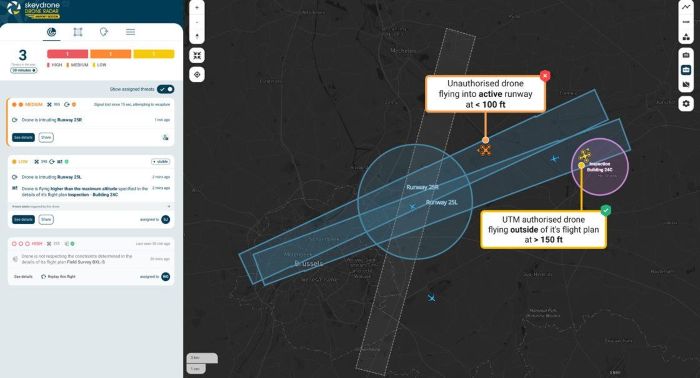
Unlike traditional systems that flood controllers with alerts for every bird-sized object, RunwaySafe uses a dynamic approach. The platform visualizes drone activity within a 3D airport environment, automatically adapting its monitoring based on which runways are currently active.
Key Capabilities of the RunwaySafe Ecosystem:
- 3D Airport Threat Zones: Mapped specifically to approach paths and critical taxiways.
- Dynamic Configuration: The system updates in real-time to reflect current ATC runway modes.
- Advanced Classification: AI-driven filtering drastically reduces false alarms and unnecessary escalations.
- Unified Awareness: Seamless integration between ATM (Air Traffic Management) and UTM (Unmanned Traffic Management).
- Multi-Sensor Integration: Combines radar, RF, acoustic, and visual data for a 360-degree view.
Compliance and Global Safety Standards
The development of RunwaySafe was not done in a vacuum. It involved skeyes, one of Europe’s most prominent Air Navigation Service Providers (ANSPs), ensuring the tech works in the world’s most complex airspaces.
The solution is fully aligned with frameworks established by EASA, ICAO, ACI, and IATA. Furthermore, it strictly adheres to the DITTA methodology (Detection, Identification, Tracking, and Threat Assessment), making it a future-proof investment for international hubs looking to bolster their security infrastructure.
FAQ: Understanding RunwaySafe and Airport Security
RunwaySafe is an intelligent threat assessment platform that categorizes drone sightings based on their actual risk to flight paths. It prevents unnecessary airport closures by allowing ATC to see which drones are genuinely dangerous and which are irrelevant to current operations.
The system uses multi-sensor integration and 3D threat zoning to filter out non-threatening objects. By aligning with real-time runway configurations, it only alerts staff when a drone enters a zone that interferes with active takeoff or landing corridors.
Yes, the platform is designed to meet the rigorous standards of EASA, ICAO, and IATA. It follows the internationally recognized DITTA methodology, ensuring that the data and threat assessments are valid for official aviation safety reporting.
A New Era for Airport Resilience
By transforming raw data into actionable insight, this technology helps airports minimize the financial impact of drone incidents. Instead of hours of grounding, airports can now restore operations with confidence, knowing exactly where the threat is—and, more importantly, where it isn’t.
Do you think AI-driven threat assessment is the key to ending drone-related flight delays? Share your thoughts in the comments below!