

Global Air Traffic Management leaders unite to launch a groundbreaking people-centred framework designed to orchestrate continuous system-wide transformation.
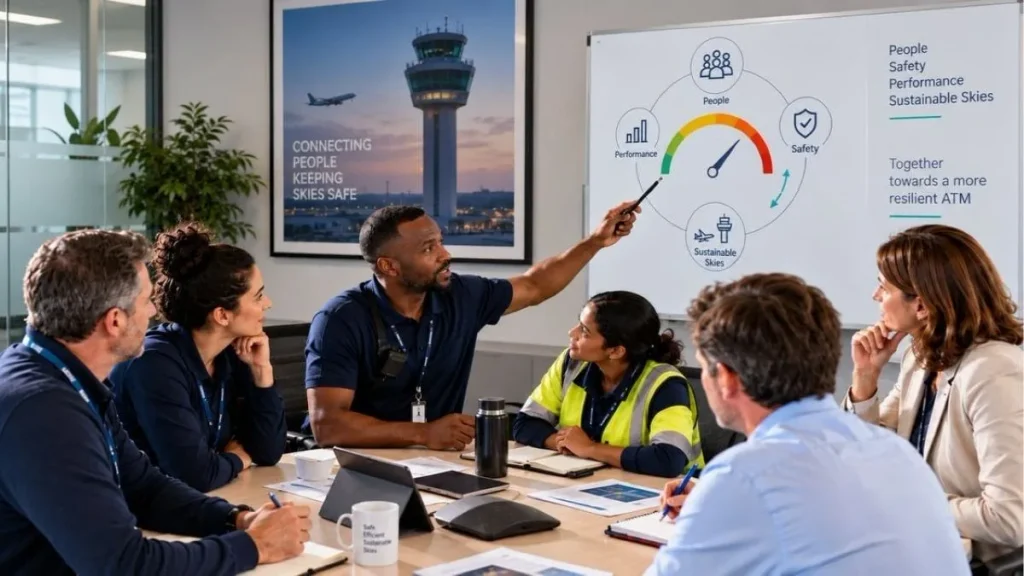
The aviation sector is standing at a critical turning point where isolated upgrades are no longer enough to keep up with modern demands. Managing change across a system that operates 24/7 requires a completely fresh strategy.
Recognizing this operational reality, five leading global organizations have joined forces to challenge traditional approaches to aviation transformation. By releasing a landmark white paper, they are shifting the industry focus from simple technology deployments toward a holistic, human-centred model. You can explore the complete vision outlined in the official white paper on orchestrating transformation in our skies.
Global Air Traffic Management Demands a System-Wide Strategy
Modern air navigation services are no longer just updating individual software packages or replacing radar towers one by one. The industry is navigating an unprecedented era of interconnected innovation where digital technology, artificial intelligence, and automated operational procedures directly collide.
When isolated projects are executed in silos, cumulative changes can easily create hidden friction across workforce lines. A single adjustment made in one sector can trigger unexpected consequences somewhere else entirely. That is why industry leaders are calling for a unified operational strategy. To understand how international service providers coordinate these efforts globally, check out our analysis of CANSO initiatives in modern aviation.
+-----------------------------------------------------------------------+
|                 SYSTEM-WIDE TRANSFORMATION ROADMAP                    |
+-----------------------------------------------------------------------+
|  STRATEGY  -->  GOVERNANCE  -->  SAFETY INTELLIGENCE  -->  PEOPLE     |
+-----------------------------------------------------------------------+
|            Result: Safe, Continuous & Coherent Transformation          |
+-----------------------------------------------------------------------+
Safety as the Driving Engine of Aviation Innovation
A common misconception in complex industries is that safety acts as a barrier to rapid progress. However, this joint white paper challenges that assumption head-on, proving that robust safety intelligence actually gives organizations the confidence to move forward.
The greatest operational risks rarely lie in the finalized future state; instead, they emerge during the transition period. Managing legacy and next-generation systems side by side requires high adaptability. Maintaining safety integrity throughout this journey ensures that structural evolutions remain both resilient and reliable.
Placing People at the Center of Modern Air Traffic Management
As automation and artificial intelligence become deeply embedded into daily operations, human expertise remains irreplaceable. Technology shifts complexity rather than removing it, making operational judgment, contextual awareness, and clear accountability more vital than ever.
Rather than treating controllers and technical specialists as passive recipients of new tools, forward-thinking organizations engage them as active co-designers. Listening to operational feedback early helps identify workload bottlenecks before they impact daily management. For more in-depth analyses on overall sector modernization, explore our comprehensive guide to ATM system evolutions and market trends.
Deployment Is Not the Finish Line: Measuring True Operational Success
Installing a technical solution on schedule does not automatically equal success. True transformation occurs only when a new capability is fully understood, safely adopted, and consistently delivers tangible operational benefits across the airspace.
The white paper provides a adaptable framework rather than a rigid rulebook. It encourages leadership teams to evaluate their organizational readiness, governance structures, and absorption capacity continuous change requires long-term commitment rather than short-term project deadlines.
FAQ: Global Air Traffic Management Transformation Framework
The new framework is a practical, people-centred strategy launched jointly by leading aviation bodies to manage continuous, system-wide changes safely and cohesively across air navigation operations.
Human expertise remains crucial because automation redistributes operational complexity rather than eliminating it. Involving staff early ensures new tools are safely adopted and practical operational realities are addressed from day one.
The paper was convened by the Global ATC Alliance and CANSO, alongside IFATCA, IFATSEA, and IFAIMA, with support from academic and independent aviation experts.
Conclusion: Shaping the Future of Air Traffic Management Together
The future of aviation will be defined just as much by how we transform as by what we transform. By breaking down traditional organizational boundaries, the global aviation community is establishing a sustainable path forward where technology and human expertise work in perfect harmony.
What are your thoughts on this people-centred approach to aviation change? Do you think involving operational staff earlier in the design process will accelerate safe technology adoption? Leave your thoughts and join the conversation in the comments section below!