
France marks a historic aviation milestone as Free Route Airspace (FRA) reaches 100% coverage above 30,500 feet, transforming European skies.
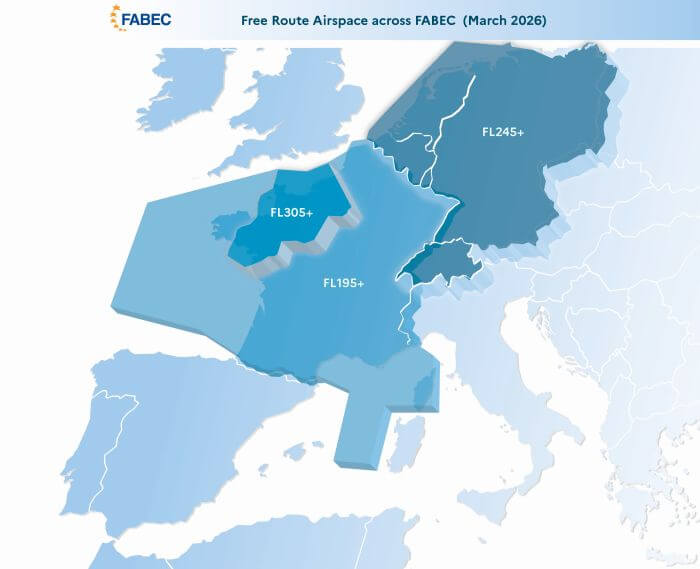
The future of sustainable flight has arrived in the heart of Europe. As of March 19, 2026, the implementation of Free Route technology is officially complete across all French upper airspace. This transition represents a monumental shift from rigid, « highway-style » air corridors to a flexible, user-centric system that prioritizes efficiency and the environment.
A Seamless Sky Across 2 Million km²
Free Route is now the standard for aircraft operating above FL 305 (approximately 9,500 meters) in France. By removing fixed air routes, pilots can now plan trajectories that are more direct, crossing borders within the FAB Europe Central (FABEC) area without the constraints of traditional geographical waypoints.
This seamless 2 million km² area—comprising Belgium, France, Germany, Luxembourg, the Netherlands, and Switzerland—now functions as a unified block of efficiency. This achievement is not just a local success; it is a vital component of the European CP 1 regulation aimed at modernizing air traffic management across the continent.
Breaking Down the March 2026 Milestone
While 70% of French airspace above FL 195 has been operating under these protocols since 2024, the final « cell » activated today completes the puzzle. Reaching 100% coverage required more than just a software update; it involved a massive redesign of the upper airspace structure.
The DSNA (Direction des Services de la Navigation Aérienne) worked in close coordination with military authorities to enhance the Advanced Flexible Use of Airspace (A-FUA). This ensures that while airlines enjoy more direct paths, national security and military training requirements remain fully integrated. By updating technical configurations in Air Traffic Management (ATM) systems, France has effectively deleted the « invisible fences » of the sky.
Environmental Benefits and Fuel Savings
The primary driver behind the Free Route initiative is sustainability. When aircraft fly shorter, more predictable routes, the benefits are immediate and measurable:
- Reduced Fuel Burn: Shorter distances mean less kerosene consumed per flight.
- Lower Emissions: A direct correlation exists between route optimization and the reduction of CO2 and NOx gases.
- Operational Safety: Improved alignment with actual flight plans reduces the « surprises » air traffic controllers face, leading to calmer, safer cockpits.
This environmental milestone aligns with the provider’s broader sustainability goals, recently highlighted when the DSNA received CANSO GreenATM Level 3 accreditation for its commitment to reducing its carbon footprint.
For a deeper look at how these technologies integrate with global standards, you can explore our aviation innovation guide to see the technical specs behind these changes.
Free Route: Powering the SESAR Vision
This deployment makes it significantly easier to utilize SESAR (Single European Sky ATM Research) solutions. Specifically, tools like Business Trajectories and User Preferred Routing can now be exploited to their full potential.
The SESAR Deployment Manager has been instrumental in synchronizing these efforts, ensuring that the French transition aligns perfectly with neighboring ANSPs. As the heart of Europe, the FABEC region handles some of the world’s most complex traffic; making it « Free Route » is a game-changer for the entire network.
DSNA: Managing Record-Breaking Traffic
The scale of this achievement is best understood through the lens of the DSNA’s workload. In 2025, the French provider handled an incredible 3.5 million flights.
Looking ahead, expectations are even higher. Just recently, on July 18, 2026, the DSNA set a new European record by managing 11,963 flights in a single day. Managing such volume while transitioning to a total Free Route environment highlights the expertise of the 7,000 staff members operating across 5 Area Control Centers (ACCs) and 75 control towers.
FAQ: Understanding the Free Route Transition
Free Route Airspace (FRA) allows pilots to choose a path between a defined entry and exit point rather than following pre-set tracks. This flexibility enables direct routing, which saves time, fuel, and reduces the overall environmental footprint of the flight.
By allowing aircraft to fly the most direct path possible, FRA significantly reduces fuel consumption and CO2 emissions. It is a cornerstone of the aviation industry’s commitment to reaching « Net Zero » by optimizing every nautical mile flown.
FABEC involves six countries (Belgium, France, Germany, Luxembourg, the Netherlands, and Switzerland) and seven major Air Navigation Service Providers. Together, they manage the most congested airspace in Europe, ensuring safety and fluidity across borders.
Free Route: A Greener Horizon
The full deployment of Free Route in France is a testament to what international cooperation can achieve. By prioritizing efficiency and environmental stewardship, the DSNA and its FABEC partners have set a new global benchmark. As we move further into 2026, the skies are not just busier—they are smarter.
What do you think about the shift toward Free Route Airspace? Do you think this is the most effective way to reduce aviation’s carbon footprint? Share your thoughts in the comments below!