Close Menu
AerobernieAerobernie
    Facebook X (Twitter) Instagram Pinterest YouTube Tumblr LinkedIn RSS
    Sur toutes les fréquences
    • Finnair renforce son réseau au Japon avec trois vols quotidiens vers Tokyo l’été prochain
    • Aéronautique et spatial : une rentrée placée sous le signe de l’emploi dynamique
    • Malaysia Airlines triomphe aux Skytrax World Airline Awards 2026
    • 35e édition du Salon des formations et métiers aéronautiques
    • Flight Safety Center : Thales mise sur la culture sécurité à Bordeaux
    • SANS Achieves Level 2 Accreditation in CANSO’s GreenATM Programme
    • Air France et SNCF Voyageurs étendent leur offre Train + Air à l’ensemble des trains OUIGO
    • Air France triomphe et décroche le titre de meilleure Première classe au monde
    mardi 29 septembre 2026
    Aerobernie Journal Web Logo
    AerobernieAerobernie
    Facebook X (Twitter) Instagram LinkedIn RSS
    • Actualités
    • Aéroports
      Hall A - Vue extérieure Crédit photo : SA ADBM

      Bordeaux Aéroport franchit un cap décisif et obtient le niveau 4 de l’Airport Carbon Accreditation

      9 septembre 2026
      Crédit photo : @_YAKIND_ PONEY CLUB | Toulouse

      150 000 spectateurs au Poney Club : le triomphe du seul festival open air d’aéroport

      7 septembre 2026
      Statue de la Liberté

      Aéroport Nice Côte d’Azur : une quatrième liaison vers New York consacre son leadership transatlantique

      30 août 2026
      Aéroport de Toulouse Blagnac

      Aéroport Toulouse-Blagnac : Bilan dynamique du trafic au 2e trimestre 2026

      29 août 2026
      Le Capitole - Washington -USA

      United Airlines : vol direct entre Toulouse et Washington

      27 août 2026
    • Trafic Aérien (ATM)
      Eng. Abdulaziz Al-Zaid, CEO at SANS, and Andreas Poetzsch, Managing Director at DAS, at the signing of the MoU / DFS Aviation Services

      SANS and DFS Aviation Services Establish Strategic Partnership to Advance Air Navigation Services

      20 septembre 2026
      Global Air Traffic Management

      Global Air Traffic Management: Orchestrating Continuous Transformation in Our Skies

      13 septembre 2026
      DFS Aviation welcomes Egypt’s NANSC delegation to Germany

      DFS Aviation Strengthens Strategic Partnership with Egypt’s NANSC Delegation in Germany

      6 septembre 2026
      Un avion de ligne en contre‑jour survole un vaste ciel bleu strié de nuages fins, évoquant le voyage et le mouvement.

      FREQUENTIS and DSNA Deliver Next-Generation Voice Communication at Brest Area Control Centre

      3 septembre 2026
      Un avion de ligne en contre‑jour survole un vaste ciel bleu strié de nuages fins, évoquant le voyage et le mouvement.

      Estonia Pioneering Europe’s Digital NOTAM Transformation with Frequentis

      10 août 2026
    • Drones & Mobilités
      1. UAV & Drones Pros
      2. Mobilité Aérienne Urbaine
      3. eVTOL
      4. View All
      Drone Volt

      DRONE VOLT signe un accord majeur avec Tonner Drones autour d’Azur Drones

      31 août 2026
      DJI lance le parachute AP100 pour Matrice 400

      Le parachute AP100 révolutionne la sécurité du DJI Matrice 400

      15 juillet 2026
      DJI Agriculture révolutionne l'agriculture de précision avec le lancement mondial des systèmes de pulvérisation à double batterie Agras T55 et T100.

      DJI Agras T55 et T100 : L’agriculture de précision passe à la vitesse supérieure

      8 juillet 2026
      FREQUENTIS recognised for its low-altitude air picture and military UTM capability for the German Armed Forces

      Frequentis Leads Military UTM Innovation for German Armed Forces

      5 juillet 2026
      Asakusa, Taito City, Tokyo, Japon

      Finnair renforce son réseau au Japon avec trois vols quotidiens vers Tokyo l’été prochain

      27 septembre 2026
      inspection avant un vol

      Aéronautique et spatial : une rentrée placée sous le signe de l’emploi dynamique

      26 septembre 2026
      Malaysia Airlines élue « Best Airline Staff in Asia » aux Skytrax World Airline Awards 2026

      Malaysia Airlines triomphe aux Skytrax World Airline Awards 2026

      25 septembre 2026
      35e édition du Salon des formations et métiers aéronautiques

      35e édition du Salon des formations et métiers aéronautiques

      25 septembre 2026
      Asakusa, Taito City, Tokyo, Japon

      Finnair renforce son réseau au Japon avec trois vols quotidiens vers Tokyo l’été prochain

      27 septembre 2026
      inspection avant un vol

      Aéronautique et spatial : une rentrée placée sous le signe de l’emploi dynamique

      26 septembre 2026
      Malaysia Airlines élue « Best Airline Staff in Asia » aux Skytrax World Airline Awards 2026

      Malaysia Airlines triomphe aux Skytrax World Airline Awards 2026

      25 septembre 2026
      35e édition du Salon des formations et métiers aéronautiques

      35e édition du Salon des formations et métiers aéronautiques

      25 septembre 2026
      Introducing Halo: Archer’s Commercial Variant of Dual-Use Autonomous VTOL Aircraft Platform Developed With Anduril

      Archer Halo Unveiled: The Future of Autonomous VTOL

      22 juillet 2026
      Eve Air Mobility

      Eve Air Mobility Takes Center Stage at Farnborough 2026

      16 juillet 2026

      Thales to Build Singapore’s Drone Traffic Management Platform

      26 mai 2026
      Vertical Aerospace Selects Evolito as Electric Engine Partner for Valo

      Evolito to Power Vertical Aerospace’s Valo eVTOL Commercial Flight

      9 février 2026
    • Compagnies Aériennes
      Asakusa, Taito City, Tokyo, Japon

      Finnair renforce son réseau au Japon avec trois vols quotidiens vers Tokyo l’été prochain

      27 septembre 2026
      Malaysia Airlines élue « Best Airline Staff in Asia » aux Skytrax World Airline Awards 2026

      Malaysia Airlines triomphe aux Skytrax World Airline Awards 2026

      25 septembre 2026
      Air France remporte le prix de la meilleure Première classe au monde aux World Airline Awards 2026 de Skytrax

      Air France triomphe et décroche le titre de meilleure Première classe au monde

      21 septembre 2026
      logo transavia

      Vol Paris-Orly et Toulouse : Transavia renforce son offre et mise sur l’Airbus A320neo

      21 septembre 2026
      Hôtesse de l'air Rwandair

      RwandAir remporte le prix du Meilleur service du personnel aérien en Afrique aux Skytrax Awards 2026

      20 septembre 2026
    • Voyage
      Air France et SNCF Voyageurs étendent l’offre d’intermodalité Train + Air à l’ensemble des trains OUIGO

      Air France et SNCF Voyageurs étendent leur offre Train + Air à l’ensemble des trains OUIGO

      22 septembre 2026
      Deux personnes souriantes trinquent

      Sainte-Lucie : Immersion au cœur de la culture du rhum

      8 septembre 2026
      Ponte Cavour, Rome, Metropolitan City of Rome Capital, Italy

      Prolonger l’été : 7 escapades d’exception pour conjurer le blues de la rentrée

      6 septembre 2026
      Condor en vol, belvédère de la Cruz del Cóndor © Miguel Mejía / PROMPERÚ

      Arequipa et la vallée du Colca : 3 expériences incontournables pour une escapade bien-être d’exception

      24 août 2026
      La Jordanie célèbre l'inscription de la réserve marine d'Aqaba au patrimoine mondial de l'UNESCO

      Jordanie : La réserve marine d’Aqaba au patrimoine mondial de l’UNESCO

      20 août 2026
    • Carrières
      • Emploi & Recrutement
      • Formations Aéro
    • Contact
    AerobernieAerobernie
    EASA lays out its proposed conditions for return to service of the Boeing 737 MAX

    EASA lays out its proposed conditions for return to service of the Boeing 737 MAX

    BernieBy Bernie24 novembre 2020 Aviation News Aucun commentaire7 Mins Read
    Facebook Twitter LinkedIn Email

    The European Union Aviation Safety Agency (EASA) published a Proposed Airworthiness Directive (PAD) concerning the Boeing 737 MAX for public consultation, signalling its intention to approve the aircraft to return to Europe’s skies within a matter of weeks. 

    aerobernie easa european union aviation safety agency

    Proposed conditions for return to service of the Boeing 737 MAX

    The Boeing 737 MAX was grounded by EASA on March 12, 2019, following two accidents with total loss of aircraft in which 346 people died. Intense work involving the dedicated attention from around 20 EASA experts over a period of around 20 months has now given EASA the confidence to declare the aircraft will be safe to fly again. The Federal Aviation Administration of the United States (FAA), State of Design for Boeing aircraft, published its final approval of the modified 737 MAX in the Federal Register on November 20, 2020. 

    “EASA made clear from the outset that we would conduct our own objective and independent assessment of the 737 MAX, working closely with the FAA and Boeing, to make sure that there can be no repeat of these tragic accidents, which touched the lives of so many people,” said EASA Executive Director Patrick Ky. 

    “I am confident that we have left no stone unturned in our assessment of the aircraft with its changed design approach,” he added. “Each time when it may have appeared that problems were resolved, we dug deeper and asked even more questions. The result was a thorough and comprehensive review of how this plane flies and what it is like for a pilot to fly the MAX, giving us the assurance that it is now safe to fly.” 

    Investigations into the two accidents showed that a primary cause in each was a software function programme known as the Manoeuvring Characteristics Augmentation System (MCAS), which was intended to make the aircraft easier to handle. However, the MCAS, guided by only one Angle of Attack (AoA) sensor, kicked in repeatedly if that sensor malfunctioned, pushing the nose of the aircraft downward multiple times and leading finally in both accidents to a complete loss of control of the aircraft.

    “EASA’s review of the 737 MAX began with the MCAS but went far beyond,” Ky said. “We took a decision early on to review the entire flight control system and gradually broadened our assessment to include all aspects of design which could influence how the flight controls operated. This led, for example, to a deeper study of the wiring installation, which resulted in a change that is now also mandated in the Proposed Airworthiness Directive. We also pushed the aircraft to its limits during flight tests, assessed the behaviour of the aircraft in failure scenarios, and could confirm that the aircraft is stable and has no tendency to pitch-up even without the MCAS.”

    Human factor analysis was another focus area – to ensure that the pilots were provided with the right alerts in the cockpit if a problem arose, along with the procedures and training needed to know how to respond. A fundamental problem of the original MCAS is that many pilots did not even know it was there. In the accident version of the aircraft, there was no caution light to make a pilot aware that the AoA sensor was faulty, making it almost impossible to determine the root cause of the problem.

    That is why EASA now proposes that the changes to the aircraft design which will be required by the final Airworthiness Directive will be accompanied by a mandatory training programme for pilots, including flight simulator training, to ensure that the pilots are familiar with all aspects of the flight control system of the 737 MAX and will react appropriately to typical failure scenarios. 

    The EASA Proposed Airworthiness Directive is now open for a 28-day consultation period. Once that ends, EASA will take time to review the comments made, before publishing its final Airworthiness Directive. That final publication is expected from mid-January 2021 and will constitute the formal ungrounding decision of the plane for all 737 MAX aircraft operated by operators from EASA Member States. After the return to service, EASA has committed to monitor the plane closely in-service, to allow for early detection of any problems that may arise. 

    In conjunction with the Proposed Airworthiness Directive, EASA also issued a Preliminary Safety Directive for 28-day consultation. This will require non-European airlines which are holders of EASA third country operator (TCO) authorisation to implement equivalent requirements, including aircrew training. This will allow for the return to service of the 737 MAX when the aircraft concerned are operated under an EASA TCO authorisation into, within or out of the territory of the EASA Member States.


    Additional information

    In summary, the EASA Proposed Airworthiness Directive mandates the following main actions: 

    • Software updates for the flight control computer, including the MCAS
    • Software updates to display an alert in case of disagreement between the two AoA sensors
    • Physical separation of wires routed from the cockpit to the stabiliser trim motor
    • Updates to flight manuals: operational limitations and improved procedures to equip pilots to understand and manage all relevant failure scenarios
    • Mandatory training for all 737 MAX pilots before they fly the plane again, and updates of the initial and recurrent training of pilots on the MAX
    • Tests of systems including the AoA sensor system
    • An operational readiness flight, without passengers, before commercial usage of each aircraft to ensure that all design changes have been correctly implemented and the aircraft successfully and safely brought out of its long period of storage. 

    For details, see the text of the Proposed Airworthiness Directive.

    EASA, and regulators in Canada and Brazil, worked closely with the FAA and Boeing throughout the last 20 months to return the plane safely to operations.

    The EASA Proposed Airworthiness Directive requires the same changes to the aircraft as the FAA, meaning that there will be no software or technical differences between the aircraft operated by the United States operators and by the EASA member states operators (the 27 European Union members plus Iceland, Liechtenstein, Norway and Switzerland. The United Kingdom is until 31 December 2020 also treated as an EU member state.)     

    However, EASA’s requirements differ from the FAA in two main respects. EASA explicitly allows flight crews to intervene to stop a stick shaker from continuing to vibrate once it has been erroneously activated by the system, to prevent this distracting the crew. EASA also, for the time being, mandates that the aircraft’s autopilot should not be used for certain types of high-precision landings. The latter is expected to be a short-term restriction. 

    The mandated training for pilots is broadly the same for both authorities. 

    Before individual airlines can assign the plane to their flight schedules, they will need to complete all the software upgrades and maintenance actions described in the final Airworthiness Directive. They also need to train their 737 MAX pilots. As there are only a limited number of simulators, this may take some time to schedule. Some of this work can be started now, even in advance of the final Airworthiness Directive publication.

    Some EASA member states issued their own decision prohibiting the operation of the 737 MAX last year for their sovereign airspace. These bans will need to be lifted before the aircraft can fly again in the airspace of these countries.  EASA is working closely with the relevant national authorities to achieve this.     

    EASA has also agreed with Boeing that the manufacturer will work to even further increase the resilience of the aircraft systems to AoA sensor failures so as to further enhance the safety of the aircraft. Boeing will also conduct a complementary Human Factor assessment of its crew alerting systems within the next 12 months, with the aim of potentially upgrading these to a more modern design approach. 

    Faites décoller la nouvelle Facebook Twitter LinkedIn Email
    Previous ArticleBiométrie faciale – équipage de cabine
    Next Article L’état du pavillon français : où en est-on aujourd’hui face à la 2ème vague du Covid-19
    Bernie
    • Website
    • Facebook
    • X (Twitter)
    • Instagram
    • LinkedIn

    Expert en navigation aérienne et gestion du trafic (ATM) avec plus de 40 ans d'expérience, Bernie est diplômé de l'ENAC et fondateur du journal Aerobernie (Promotion OCCA 80B). Ancien Ingénieur du Contrôle de la Navigation Aérienne (ICNA) à Lyon-Satolas et au CRNA-Est, il a poursuivi sa carrière à l'ENAC et à la DTI. Son expertise l'a mené à réaliser de nombreuses missions de conseil international (Afrique, Moyen-Orient, Chine). Fondateur de Aerobernie, éditeur et chroniqueur aéronautique depuis plus de 10 ans, il décrypte aujourd'hui sur Aerobernie les enjeux du secteur : des infrastructures mondiales aux mobilités innovantes (eVTOL, drones).

    Le meilleur du tarmac

    Flight Safety Center

    Flight Safety Center : Thales mise sur la culture sécurité à Bordeaux

    Aviation News 24 septembre 2026
    Abdulaziz Alzaid, Chief Executive Officer of SANS

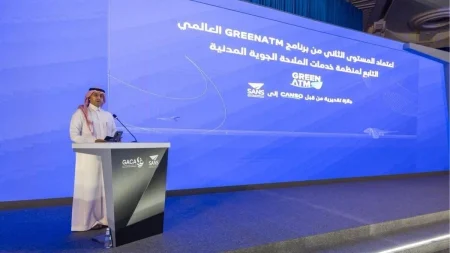
    SANS Achieves Level 2 Accreditation in CANSO’s GreenATM Programme

    Aviation News 23 septembre 2026
    Vietnam Airlines et Airbus signent un protocole d’accord portant sur cinq A350-900

    Vietnam Airlines et Airbus : Un nouvel accord historique pour cinq A350-900

    Aviation News 12 septembre 2026
    Mode Avion

    Mode Avion : AURA AERO donne la parole à celles et ceux qui font l’aviation

    Aviation News 10 septembre 2026
    Coureuses souriantes en t-shirts bleus "AERORUN"

    AéroRun 2026 : Lyon-Bron accueille la course solidaire

    Aviation News 4 septembre 2026
    Air Legend 2026

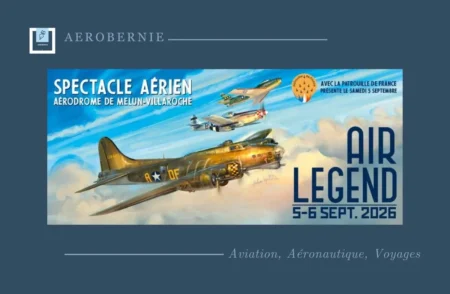
    Air Legend 2026 revient à Melun-Villaroche les 5 et 6 septembre

    Aviation News 3 septembre 2026
    Contactez la tour de contrôle Cancel Reply

    Radar de Bord
    Tableau de Bord
    • Fréquence ATM
    • Escale
    • Cap sur l’emploi
    • Salle de briefing
    • Coulisses de l’industrie
    • Escale lecture
    En Direct du Tarmac
    Asakusa, Taito City, Tokyo, Japon
    Finnair renforce son réseau au Japon avec trois vols quotidiens vers Tokyo l’été prochain
    27 septembre 2026
    inspection avant un vol
    Aéronautique et spatial : une rentrée placée sous le signe de l’emploi dynamique
    26 septembre 2026
    Malaysia Airlines élue « Best Airline Staff in Asia » aux Skytrax World Airline Awards 2026
    Malaysia Airlines triomphe aux Skytrax World Airline Awards 2026
    25 septembre 2026
    35e édition du Salon des formations et métiers aéronautiques
    35e édition du Salon des formations et métiers aéronautiques
    25 septembre 2026
    Flight Safety Center
    Flight Safety Center : Thales mise sur la culture sécurité à Bordeaux
    24 septembre 2026
    Abonnez-vous

    Saisissez votre adresse e-mail pour vous abonner à ce blog et recevoir une notification de chaque nouvel article par e-mail.

    Rejoignez l’Équipage
    • LinkedIn
    • Facebook
    • X
    • Instagram

    Bernieshoot — voyage, gastronomie & photographie


    Rainfolk — blog littéraire
     

    Facebook X (Twitter) Instagram Pinterest LinkedIn RSS
    • A propos
    • Mentions Légales
    • Politique de confidentialité
    • Nos Services
    • Nos Partenaires
    • Contact
    © 2026 Créé par et pour Aerobernie.com

    Tapez votre recherche ci-dessus et faîtes Entrée. Tapez Echap pour annuler.