

FIFA World Cup 2026 is set to be the biggest sporting spectacle in history, but behind the scenes, a massive logistical operation is already underway to prepare the skies over Latin America and the Caribbean.
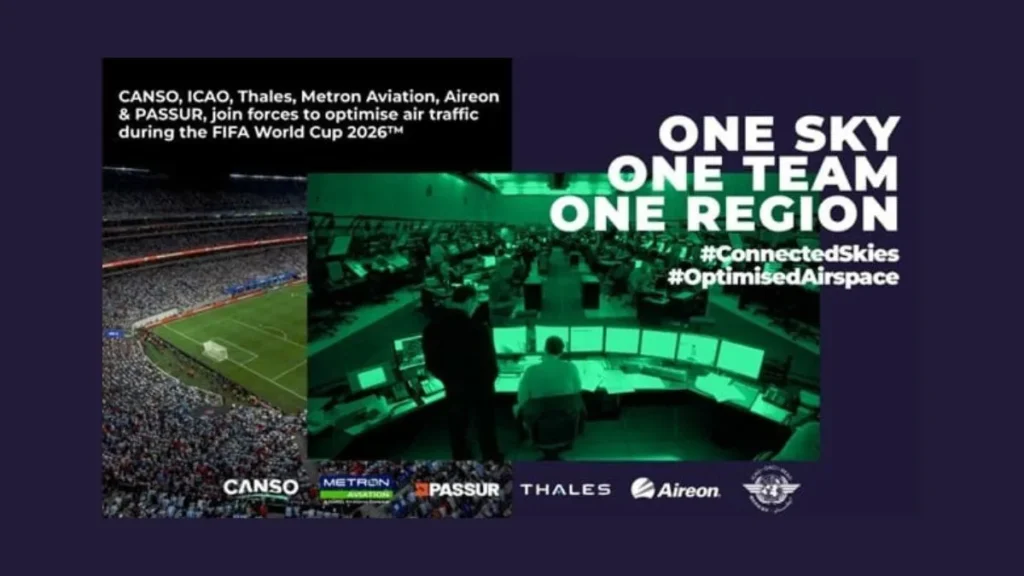
As the countdown to the FIFA World Cup 2026 begins, aviation industry heavyweights have formed a landmark partnership. Their mission? To provide critical support to Air Navigation Service Providers (ANSPs) across the Latin American and Caribbean (LAC) region, ensuring that millions of fans reach their destinations without a hitch.
FIFA World Cup 2026: Orchestrating a Regional Aviation Revolution
To handle the unprecedented surge in air traffic, the Civil Air Navigation Services Organisation (CANSO) and the International Civil Aviation Organization (ICAO) have joined forces with technology giants Thales, Metron Aviation, PASSUR Aerospace, and Aireon. This collaboration is about more than just managing flights; it is about creating a unified technological ecosystem designed for high-stakes efficiency.
This initiative is particularly vital given the complexities of regional travel. By deploying advanced predictive analytics and flow management tools, these organizations are empowering local ANSPs to maintain safety standards while drastically reducing operational friction. You can explore more about these advancements in regional coordination through the latest updates on aviation news.
Transforming Air Traffic Management with Predictive Power
The core of this strategy lies in anticipating the unknown. With millions of fans, national teams, and international delegations converging, the system must be agile. The partnership is equipping the region with:
- High-fidelity modelling: To predict traffic spikes weeks before they occur.
- Real-time adjustments: Utilizing flight path optimization to reduce delays and minimize fuel burn.
- Data-sharing protocols: A « One Sky » approach that allows neighboring Flight Information Regions (FIRs) to synchronize seamlessly.
This focus on operational excellence mirrors the rigorous standards often discussed in global efforts to improve ATM performance levels. By integrating these tools, the region is preparing to turn a logistical hurdle into an operational success story.
A Unified Vision for the Skies
Simon Hocquard, President and CEO of CANSO, emphasized the human impact of this technical work: « Our goal is to work together across the region to keep flights running smoothly so fans can focus on enjoying the tournament. »
This is not just about technology; it is about regional cooperation. The tools provided—ranging from Thales’s Topsky Flow Management to Aireon’s real-time surveillance data—give controllers a single, integrated view of the airspace. Such large-scale digital integration is setting a new benchmark for how global events are managed, much like the evolving conversations surrounding next-generation airspace management strategies.
Moreover, training remains a cornerstone of this transition. As noted in industry reports on enhancing ANSP learning and training portals, the human element is being bolstered by better access to knowledge and specialized support systems.
David Antonello, Product Line Manager, ATC Digital Solutions, Thales: “We’re proud to bring TopSky – Flow Manager to the LAC region for a flawless World Cup 2026. The solution delivers high‑precision demand forecasts and real‑time capacity monitoring, turning traffic spikes into predictable, controllable flows and quickly correcting imbalances. The result: seamless, coordinated operations across neighboring FIRs, on‑time flights and reduced fuel burn.”
Paco Solvez – Director, EMEA & LATAM Sales, Aireon:
“The World Cup presents an excellent opportunity for collaboration, especially as it pertains to air traffic flow management. Team Aireon is looking forward to collaborating and supplying our world-class data to support LAC ANSPs’ operational objectives, including enhanced situational awareness, air traffic prediction capabilities, and efficient airspace management”
Chris Jordan, President, Metron Aviation, Inc. – The FIFA World Cup will place extraordinary demand on airspace across Latin America and the Caribbean, making collaboration and predictive decision-making essential. Metron Aviation is proud to support CANSO, ICAO, and the LAC region through the integration of COMPASS into daily operations—enabling ANSPs to monitor and publish ATFM Daily Plans, advisories, traffic management measures, and delays, while sharing a common operational picture and gaining insight into regional constraints to support proactive, coordinated traffic flow management.
Josué González, Regional Officer, Air Traffic Management and Search and Rescue, ICAO: “Preparing for the FIFA World Cup 2026 presents a significant opportunity for the aviation community to strengthen regional cooperation, coordination, and air traffic management across Latin America and the Caribbean. By collaborating, ICAO, CANSO, IATA, States, ANSPs, and industry partners can adopt a unified approach to manage increased traffic and ensure safe, efficient, and resilient operations.”
FAQ: Managing Airspace for Major Events like FIFA World Cup 2026
Predictive analytics allow ANSPs to model traffic patterns weeks in advance, enabling controllers to proactively balance capacity and prevent congestion, which significantly reduces the risk of operational errors.
A « One Sky » approach facilitates real-time data sharing across borders, allowing neighboring regions to harmonize flight paths and reduce delays that typically occur when traffic moves through fragmented, uncoordinated airspaces.
The initiative utilizes a combination of advanced flow management software (like Thales Topsky), high-fidelity traffic visualization tools, and global satellite-based surveillance data to provide a comprehensive, real-time picture of regional air traffic.
Conclusion: Ensuring a Memorable Journey
The success of the FIFA World Cup 2026 will be felt long before the first whistle blows. By aligning the aviation sector’s infrastructure, these leaders are proving that when the industry unites, it can overcome global operational challenges. Fans, players, and officials can look forward to a journey that is as seamless and memorable as the matches themselves.
What are your thoughts on these technological preparations for the 2026 tournament? Share your insights in the comments section below!